From mattress padding to automotive interiors, Low Melt Polyester Fiber helps manufacturers achieve consistent bonding, structural stability, and desirable product performance. Understanding its applications can help determine where this material delivers the greatest value.
Low Melt Fiber, also known as Low Melting Point Fiber, is commonly manufactured using a bicomponent structure consisting of a low-melting sheath and a higher-melting core.
During thermal processing, the sheath softens or melts at a designated temperature, creating bonding points between adjacent fibers. Meanwhile, the core maintains its fibrous structure, helping the finished material retain its shape and mechanical integrity.
This thermal bonding mechanism makes it particularly suitable for nonwoven manufacturing and polyester fiber blending.
Compared with processes that rely heavily on chemical adhesives, thermal bonding can simplify certain production procedures while providing a soft feel, good bonding effect, and stable heat shrinkage under appropriate processing conditions.
The versatility of Low Melt Fiber allows it to serve different manufacturing requirements. Its primary function is to bind surrounding fibers together, helping create stable structures without significantly compromising the characteristics of the base material.
Nonwoven manufacturing is one of the most common applications of Low Melt Polyester Fiber.
When blended with conventional polyester staple fiber (PSF), it acts as a thermal bonding component during heat treatment. This process helps produce cohesive nonwoven structures suitable for various industrial and household applications.
Its ease of bonding with other fibers also makes it useful in manufacturing thermal-bonded nonwoven fabrics where consistent thickness and structural stability are important.
Low Melt Fiber is frequently incorporated into mattress filling, sofa cushions, furniture padding, and other upholstery materials.
In these applications, it helps bond polyester fibers together while maintaining a relatively soft and resilient structure. Its good elasticity and bonding performance make it suitable for producing comfortable padding materials that require both flexibility and dimensional stability.
The resulting fiber layers can provide cushioning support while helping maintain their intended shape during normal use.
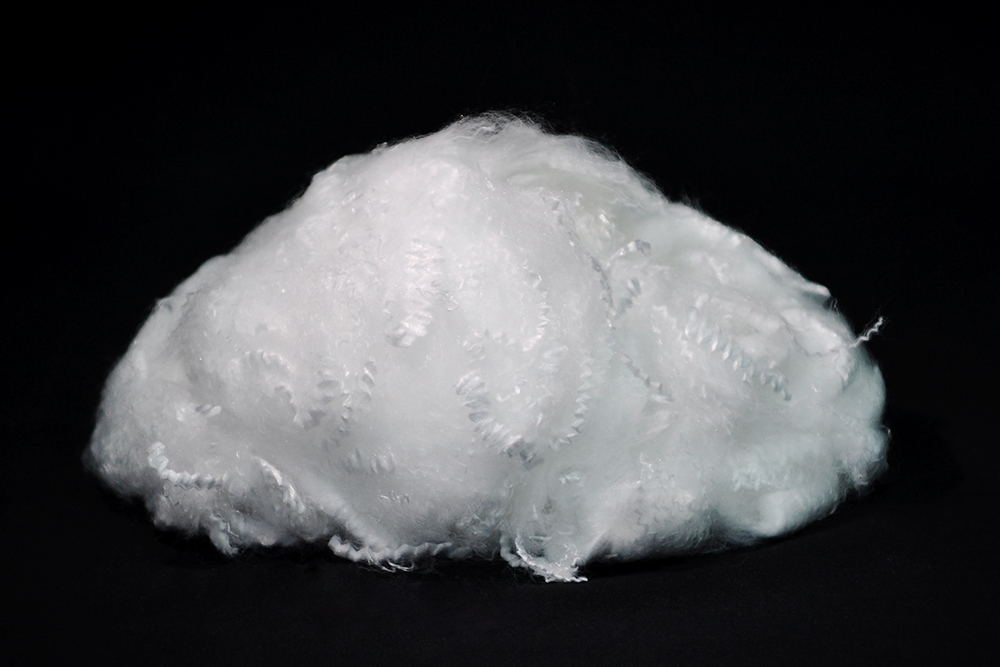
Automotive manufacturers use thermal-bonded polyester materials in various interior components, including acoustic insulation layers, interior padding, and nonwoven felt.
Low Melt Fiber helps stabilize the fiber structure during manufacturing, allowing the finished material to maintain its intended thickness and shape.
When combined with appropriately selected polyester fibers, it can contribute to the production of lightweight interior materials designed for sound absorption, cushioning, and thermal insulation.
Low Melt Fiber can also function as a bonding component in selected filtration and insulation products.
For filtration applications, thermal bonding helps maintain the integrity of the fiber network. However, the filtration performance itself depends on additional factors, including fiber diameter, pore structure, and material density.
Similarly, in thermal insulation materials, Low Melt Fiber helps stabilize the fiber arrangement while the overall insulation performance depends on the structure and composition of the finished product.
The value of Low Melt Fiber comes from its ability to combine effective thermal bonding with the desirable characteristics of polyester materials.
Several properties make it particularly useful in fiber processing:
Good bonding performance: It bonds readily with compatible fibers under suitable thermal processing conditions, helping create stable fiber structures.
Soft feel and elasticity: Proper fiber selection and processing can produce bonded materials that retain flexibility and cushioning properties.
Stable heat shrinkage: Controlled thermal behavior supports more consistent dimensional performance during manufacturing.
Processing flexibility: It can be blended with different polyester staple fibers to meet specific production requirements.
Another important consideration is raw material selection.
Both virgin and recycled polyester fiber options can support different manufacturing needs, depending on the required product specifications, material sourcing preferences, and production objectives.
Although Low Melt Fiber is suitable for numerous applications, selecting the appropriate specifications is essential for achieving consistent processing results.
Melting point is particularly important because it determines the thermal conditions required to activate the bonding component. Fiber fineness, cut length, and blending ratio also influence the structure and performance of the finished material.
For example, mattress padding generally requires a balance between softness, resilience, and bonding strength, while industrial nonwoven materials may place greater emphasis on structural stability and dimensional consistency.
Manufacturers should therefore evaluate Low Melt Fiber according to their processing equipment, base fiber composition, and intended end-use requirements.
For applications requiring reliable thermal bonding, Daxin offers Low Melt Fiber options, including 100% Virgin PSF and 100% Recycled PSF. These polyester fiber solutions feature a soft feel, good bonding effect, stable heat shrinkage, ease of bonding with other fibers, and good elasticity.
By matching fiber specifications with actual production requirements, manufacturers can develop thermal-bonded materials that balance processing efficiency, product comfort, and structural stability.