Not all polyester staple fiber is designed for the same purpose. While solid fiber remains the standard for yarns and woven fabrics, a different structural category exists specifically for bulk, softness, and warmth: hollow conjugated polyester staple fiber, commonly abbreviated as HCS. This fiber type sits behind many of the filling materials used in pillows, comforters, and cushioned products. Understanding its structure and how it is made explains why it performs so differently from ordinary solid fiber.
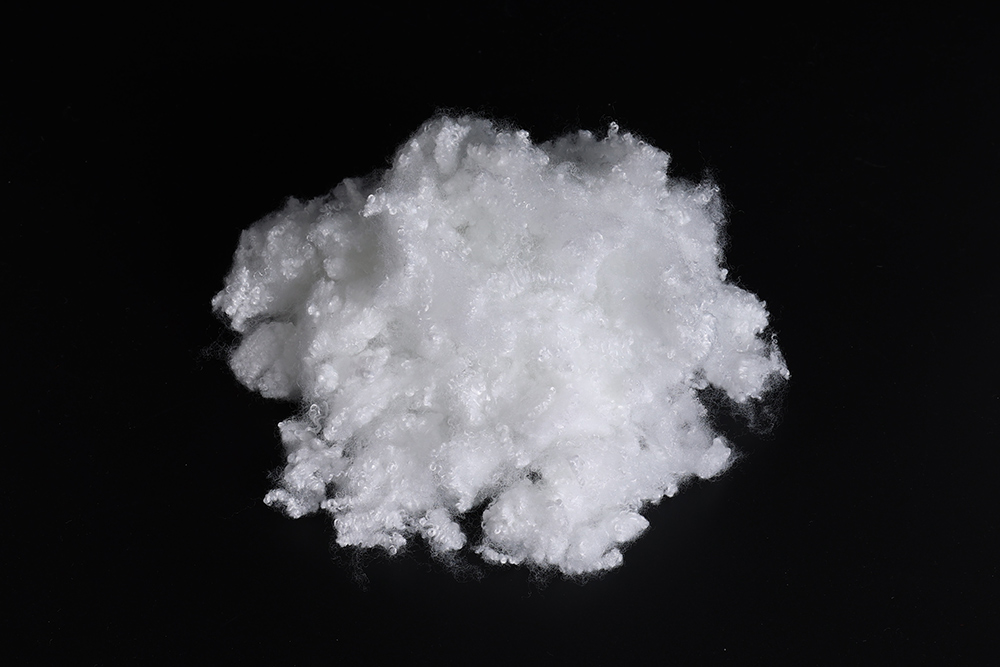
The name describes two distinct structural features combined in a single fiber.
Hollow refers to the presence of one or more continuous channels running through the length of the fiber, rather than a solid, fully filled cross-section. This internal void significantly reduces the fiber's weight relative to its volume, which is the main reason hollow fibers feel lighter and more voluminous than solid ones of the same denier.
Conjugated refers to a fiber built from two polymer components arranged side by side, or in an eccentric sheath-core configuration, within the same filament. Because the two components have slightly different shrinkage or crystallization behavior, the fiber naturally develops a three-dimensional spiral crimp as it cools — a more stable and resilient form of curl than crimp introduced purely by mechanical means.
Together, these two features are engineered for one purpose: to combine light weight with strong bulk recovery. It is common to see this fiber further identified as HCS, where the "S" stands for siliconized, indicating an additional surface treatment applied after fiber formation.
Producing hollow conjugated fiber requires modifications at the spinning stage that go beyond standard solid-fiber production.
The hollow structure is created using specially designed spinnerets with shaped orifices that form one or more internal channels as the polymer is extruded. Depending on the intended application, manufacturers may produce single-hole hollow fiber or multi-hole hollow fiber, with multi-hole structures generally offering even greater bulk and compressibility.
The conjugated structure is formed simultaneously by feeding two polymer streams — often with different intrinsic viscosities or slightly different compositions — into the same spinneret in a side-by-side or eccentric arrangement. As the extruded filament cools and the two components shrink at different rates, the fiber curls into a natural, three-dimensional spiral. This is a key distinction from mechanically crimped fiber, where waviness is imposed afterward through a stuffer box rather than generated by the fiber's own internal structure.
After spinning, drawing, and cutting, many hollow conjugated fibers undergo a silicone finishing treatment. This coating reduces surface friction between fibers, improving softness, slip, and resistance to clumping — qualities that matter significantly once the fiber is used as loose filling material.
The combination of hollow structure and conjugated crimp gives this fiber a distinct performance profile.
Light weight. The hollow channel reduces the amount of solid polymer per unit length, producing a fiber that delivers volume without adding excessive weight.
Strong bulk recovery. The spiral, three-dimensional crimp allows the fiber to compress under pressure and spring back to its original loft once the pressure is released, a property especially valued in pillow and cushion filling.
Improved insulation. The hollow core traps pockets of still air within the fiber structure, contributing to better thermal insulation compared with solid fiber of similar dimensions.
Soft, smooth handle. When combined with a silicone finish, the fiber surface becomes noticeably smoother, reducing friction between individual fibers and helping filled products maintain an even, non-clumped distribution over time.
These properties make hollow conjugated PSF the fiber of choice across several filling and cushioning applications.
Pillow filling. The fiber's loft and resilience make it a popular alternative to down and feather filling, offering a similar softness with easier care and lower cost.
Comforter and quilt filling. Its insulating properties and lightweight bulk make it well suited to bedding products designed for warmth without heaviness.
Furniture and cushion filling. Sofas, seat cushions, and other upholstered products benefit from the fiber's compression recovery, helping maintain shape and comfort over repeated use.
Toy filling. The soft, smooth handle and consistent bulk make hollow conjugated fiber a common choice for stuffed toys and similar soft goods.
Compared with solid or mechanically crimped fiber, hollow conjugated PSF is purpose-built for applications where softness, loft, and long-term resilience matter more than tensile strength — making structural design, not just raw material, a key factor in fiber selection.
If you need help choosing the right hollow conjugated fiber specification for your product, our technical team is available to provide guidance based on your application.